Jeanne Wene Old German Building and People Art Work
The creative person Christo, known for wrapping buildings including Berlin's Reichstag, and also swathing areas of coast and unabridged islands in cloth, has died aged 84. The news was confirmed on his official Facebook page, which said that he died of natural causes at his home in New York.
Built-in Christo Vladimirov Javacheff in Bulgaria, Christo studied in Sofia and then defected to the west in 1957, stowing away on a train from Prague to Vienna. 2 years afterwards he met Frenchwoman Jeanne-Claude Denat de Guillebon, who would become his artistic partner and wife until her expiry in 2009.
The couple embarked on their career of big-scale public artworks in 1961, when they covered barrels at the Port of Cologne. Barrels would feature heavily in their artworks, attributable to their low cost and sculptural appearance, along with an implied political connotation always downplayed by the artists. "I brand things that have no function – except maybe to make pleasure," Christo told the Guardian in 2018.
The following year, they barricaded a street in Paris with oil barrels. Called Rideau de Fer (Atomic number 26 Curtain), it put them on the map in the art world, and they went on to be represented by the famous Castelli gallery in New York.

The couple went on to create large-scale works which oft involved swathing vast natural monuments in material, aligning them to the American land artists of the early 70s, who created vast artworks in the desert. In 1969, Christo and Jean-Claude (as Christo billed their works after his wife's death) embarked on Wrapped Coast, which involved shrouding the coast and cliffs of Lilliputian Bay in Sydney, Commonwealth of australia, in grey fabric, to create what was the largest unmarried artwork of the time.
In 1972 they made Valley Pall, erecting an 14,000-metre orangish curtain across Burglarize Gap, a canyon in Colorado, though a storm destroyed it only a day after it was hung. All Christo and Jean-Claude's artworks were designed to be temporary. "Artists – and above all architects – seek permanence," he said. "I don't. I like leaving nothing. That takes courage."
His work was funded mainly past selling preparatory drawings – he always refused whatsoever sponsorship. "Nosotros have always been good at negotiating. And we needed to be, otherwise these projects would never accept been realised. Merely we accept always been very skilful at getting banks to supply lines of credit."

Photograph: Centre Ubiquitous/Alamy Stock Photo
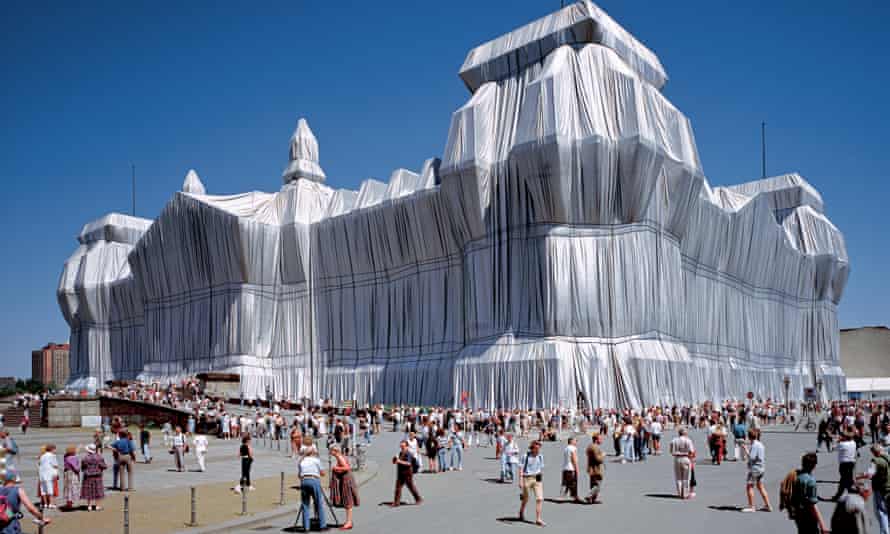
By the 80s, Christo and Jean-Claude's ambitions and reputation had grown to the extent that they were able to pull off projects including surrounding 11 islands in Miami's Biscayne Bay with bright-pinkish floating polypropylene cloth, and wrapping Pont Neuf, the oldest bridge in Paris, after the and so-mayor Jacques Chirac gave his permission. All the same the artists' near spectacular achievement arguably came in 1995, when they pulled off Wrapped Reichstag, covering the German parliament building in Berlin in aluminium material, less than half dozen years after the autumn of the Berlin wall.
"Information technology was one of the almost beautiful things I have ever seen," Christo told the Guardian. "A hundred rock climbers abseiling downwardly the facade of the Reichstag, slowly unfurling this huge silvery pall. At that place were no cranes or mechanism, just people descending in a kind of aerial ballet. It was 1995 and huge crowds came to watch. So, when information technology was finished, they came up to stroke the fabric." Keen not to cheapen the artwork, Christo forbade the Three Tenors to perform a concert in front of it.
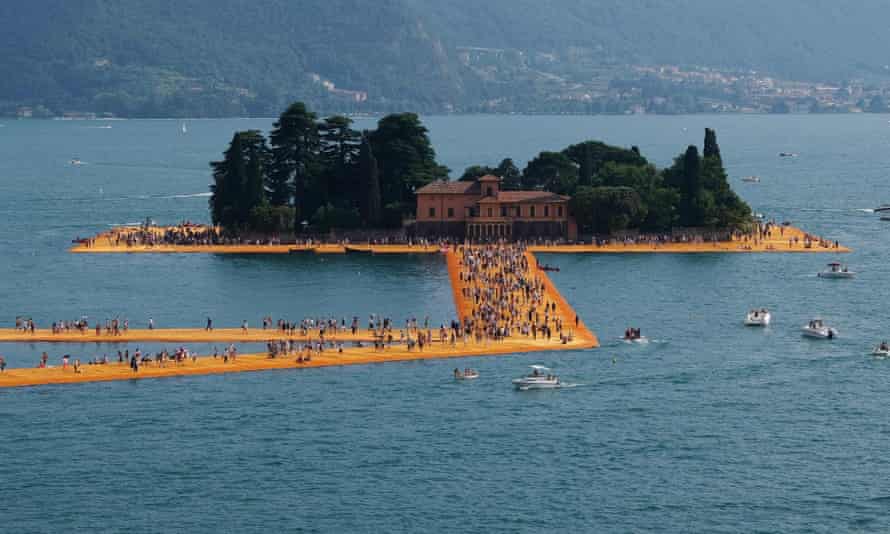
Further projects included the Gates, which saw structures with billowing saffron vinyl erected throughout New York's Central Park, and The Floating Piers at Italian republic's Lake Iseo. In summer 2018, Christo floated a stack of 7,506 barrels on the Serpentine in London's Hyde Park. The piece of work, called Mastaba, delighted and baffled viewers. "Information technology will belong to everyone until information technology's gone," the artist told the Guardian. "Information technology will exist a landmark for a few months."
The artist'southward role released the statement: "Christo lived his life to the fullest, not but dreaming upward what seemed impossible merely realising information technology. Christo and Jeanne-Claude's artwork brought people together in shared experiences across the globe, and their work lives on in our hearts and memories."
A planned work, 50'Arc de Triomphe, Wrapped, will exist made posthumously, in accordance with both artists' wishes, in Paris in September next year.
Source: https://www.theguardian.com/artanddesign/2020/may/31/christo-artist-who-wrapped-the-reichstag-dies-aged-84

Post a Comment for "Jeanne Wene Old German Building and People Art Work"