what kind of ink was used to write the constitution
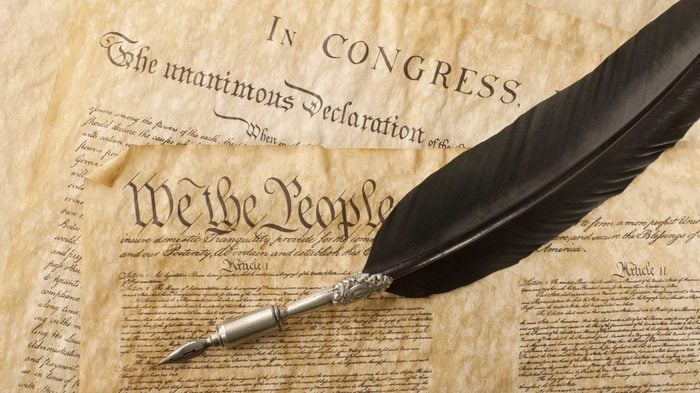
The Constitution may take earned an "A" in civics, but in terms of grammar, it'south well below the (Liberty) bong-shaped curve.
In 1787, the U.Due south. Constitution was drafted by members of the Constitutional Convention, every bit led by James Madison. On September xv, 1787, equally the convention wound down, a human named Jacob Shallus, who was a clerk for the Pennsylvania State Associates, set about committing it to "concluding course." He did so by manus, with pen and ink, as was standard for the time. Shallus did a "fine job" inscribing the more than iv,000 words beyond four large sheets of parchment paper, as the National Archives states, but that'south not to say Shallus didn't make errors, or that further errors weren't fabricated past others who had a hand in its signing and amendment. Some were substantive. Some were grammatical. Some may or may not involve a niggling of both. Afterward, test your knowledge of Constitution facts.
"Information technology'southward" non the correct spelling of "its"
"No State shall … lay whatever Imposts or Duties on Imports or Exports, except what may be absolutely necessary for executing it's Inspection Laws," reads Article 1, Section 10. As used in this clause, the give-and-take "it's" was meant to refer to the possessive of the word "it." Nevertheless, the discussion is spelled as if information technology were the contraction of "it" and "is" (i.eastward., information technology's). Considering "its" is used properly in other sections of the Constitution (see, for example, Article I, Section v, which uses "its" properly iv times), the fault hither seems to be more most careless transcription than failure to know the rules of grammar. Nosotros're willing to cutting SHallus some slack on this 1, it'due south v its is, after all, one of the 20 most confusing grammar rules.
For how long should the President preside?
Article II, Section I states, "The executive Ability shall exist vested in a President of the The states of America. He shall hold his Office during the Term of four Years…." As written, the implication is the President is to exist in office for some undefined period of fourth dimension during a term of iv years. If it were written more precisely, the word "for" would accept stood in for the word "during."
A president? Which president?
Besides a flake confusing in Article Two, Department I is the vesting of executive Power in "a" President. A more than precise way of stating this would take used the give-and-take "the" instead of "a," thus indicating that at whatsoever once, i person would hold the executive power.
Misspelling of "Pennsylvania"
When it came time for the Constitution to be signed, Alexander Hamilton helped out by writing the name of the respective states represented by the signatories. "Pensylvania," Hamilton wrote beside Benjamin Franklin'southward proper noun, omitting the second "n." No ane corrected information technology so, and no ane has corrected it since. It's especially ironic given that the Constitutional Convention was held in Philadelphia, one of the facts about the Constitution all Americans should know.
Inconsistent capitalization
In the 1700s, information technology was common practice to capitalize the get-go letter of every noun. Yet every noun is not capitalized. For instance, in the Preamble, the word "defence," which is spelled "defence" as discussed below, appears in all lower case. In Commodity I, Section 8, Clause 2 (regarding congressional borrowing power), the word "credit" does not begin with a capital "C." And in Article I, Section ix, Clause 1, "duty" is left uncapitalized. and "present" in Article I, Section 9, Clause 8. These grammar rules have inverse a lot in the last decade. but capitalization hasn't.
When the Bill of Rights was drafted two years later, Congress elected to driblet the capitalization dominion. Appropriately, the Pecker of Rights doesn't match the capitalization of the original certificate. In addition, "a few mistakes crept in," notes The Tenth Subpoena Centre. "Several of the nouns in the Beak of Rights [are] capitalized.
Failure to hyphenate a compound number
"When writing a chemical compound number—whatsoever number made upward of 2 words—we utilise a hyphen between each discussion. This applies to any number between xx-i (21) and xc-nine (99)," advises Grammarly. All the same in Commodity I, Section 2, the number 25 is written as "twenty five," without the appropriate hyphen.
British spellings
Although the United States had alleged independence from the British motherland, the Constitution employs some traditional British spellings. These include "defence" in the Preamble, as mentioned above, "controul" (which is spelled "command" in the U.s.) and "labour" (which is spelled "labor" in the Usa.). Whether you're from the Usa or U.K., avoid these overused words.
The choice to utilize "chuse"
Co-ordinate to U.South. Constitution.net, the "most common error, at least to modern eyes, is the word 'choose,' spelled 'chuse' several times." All the same, this is probable a choice to apply an alternate spelling that was used at the time, rather than an error. Both "chuse" and "chusing" tin can be constitute in the text of the Constitution.
An errant comma renders role of Commodity Ii nonsensical
"The Electors shall meet in their respective States, and vote by Ballot for two Persons…" reads the 3rd paragraph of Article II, Section I. The comma between "States" and "and vote" should betoken the presence of a noun in the clause, "And vote by Ballot of two Persons." No such noun is present, notwithstanding. Then the comma is grammatically incorrect, and only if the comma is ignored entirely, does the sentence make any sense at all.
We see this same kind of mistake throughout Article Ii, Section I, if not throughout the entire Constitution. Learn how many people actually signed the Constitution.
Failure to consistently apply Oxford commas (or not)
Whether you prefer the Oxford comma (as we do), or not, proper grammar requires choosing one and sticking with information technology throughout any particular document. That is not how the Constitution rolls, withal. Whereas the Preamble is a veritable work of Oxford comma art and is easy to parse when analyzed equally such, Article Ii, Section 4 ignores the Oxford comma when it states, "The President, Vice President and all civil Officers of the Us, shall be…."
A comma between a substantive and a verb
A substantive and a verb need to be together in the same clause of a judgement, or else information technology'due south not really a clause (which is divers as a portion of a sentence containing both noun and verb). So and so what's going on in Article III, Section I, vesting judicial ability in the Supreme Court? Information technology reads, "The judicial Power of the United states, shall be vested in 1 Supreme Court." Huh.
A misplaced semi-colon stands between the Constitution and the supreme law of the land
Article VI provides that "This Constitution, and the Laws of the United states of america which shall exist made in Pursuance thereof; and all Treaties made, or which shall be made, under the Authority of the United States, shall be the supreme Law of the Country…." Information technology seems articulate the Constitution and the Laws are intended to be the supreme police of the land just as much as Treaties are, and even so the placement of the semi-colon hither might advise otherwise nether strict grammar rules.
Questionable commas in the Second Amendment
The official version of the Second Amendment reads as follows: "A well regulated Militia, being necessary to the security of a costless State, the correct of the people to keep and acquit Arms, shall non exist infringed." Over the years, both proponents and opponents of gun control laws take used both the kickoff and second comma to support their reading of the 2nd Amendment.
Those in back up of gun command have interpreted the placement of these commas to hateful "a well-regulated militia shall non be infringed," thus connecting guns solely to service in the militia. The U.S. Supreme Courtroom has sided with those on the other side of the statement, however. In 2016, the Atlantic reported that Thomas Jefferson, one of the Founding Fathers who did not sign the Constitution considering he was in France, actually tried to introduce an alternate version without the first comma, which would have linked the correct to acquit arms solely with a well-regulated militia just that he was too late; the Amendment had already been ratified.
While these mistakes are undeniably true, these 10 "facts" nigh the Constitution that are really myths.
Sources:
- National Archives: Errors in the Constitution—Typographical and Congressional
- National Archives: The Constitution of the United States—A Transcription
- Cambridge Lexicon: During or For?
- English Language Learners Stack Exchange: How do I know when to use "the" versus "a" versus "∅" as an commodity on a noun?
- 10th Amendment Heart: The Constitution: Capitalization
- Grammarly: Hyphen in Compound Numbers
- usconstitution.net: Misspellings in the U.South. Constitution
- Supreme Court of the U.s.: District of Columbia v. Heller
- The Atlantic: The Most Consequential Comma in U.S. History?
- National Constitution Center: The Constitution of the United States: Fast FAQs
Source: https://www.rd.com/article/mistakes-in-constitution/

Post a Comment for "what kind of ink was used to write the constitution"